Not all penguins in a relationship stay true to one another. There’s a lot of drama: I’ve seen a pair of “gay” penguins split after years of companionship, a divorce after the parents’ chicks grew up, and the occasional guilty penguin that allopreens someone other than its partner. But I’ve never seen anything as scandalous as what a genetic analysis on African penguins at an Italian zoo uncovered.
In this zoo, African penguins are housed in the same exhibit as their close relatives, the Magellanic and Humboldt penguins, both of which are native to South America.
WHICH RELATIVE IS WHICH?

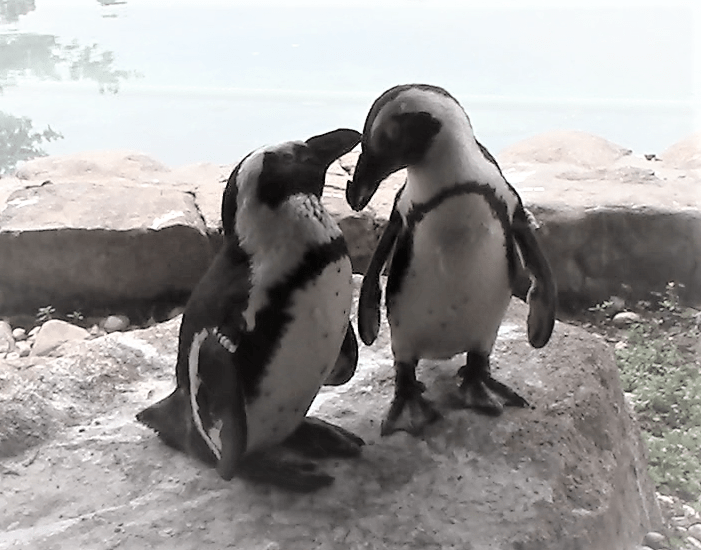
The African penguin is distinguishable by its pink, fleshy “eyebrow”, white neck, and single black band on its upper chest.
Photo courtesy of Kelsey Kehm.
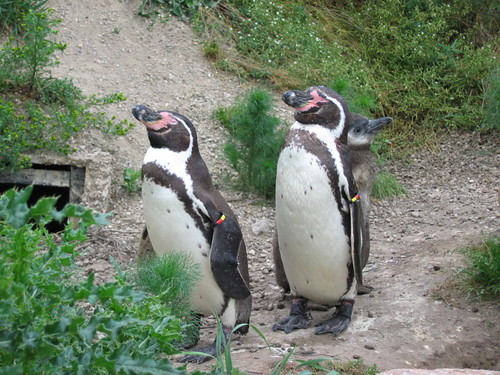
The Humboldt penguin can be identified by the single black band on its upper chest and the large, pink, fleshy area near its eye and on its beak.
Photo credit: “Pinguïns” by DutchAstrid is licensed under CC BY-NC-ND 2.0

The Magellanic penguin features a broad, black band across its throat, followed by a single, thin black band on its upper chest.
Photo credit: “P1020943.JPG” by ejbluefolds is licensed under CC BY-NC 2.0
Researchers decided to do a genetic analysis on the African penguins, exclusively, in order to see if genetic diversity is maintained in the colony and if studbook records were correct.
A studbook is a pedigree or family tree for a specific animal; just as we may record our family’s ancestors and their relationships to one another, zookeepers do the same for penguins.
Perhaps the most outrageous part of the scandal is that researchers identified four of the penguins as hybrids with Humboldt penguins, although all of them looked like African ones. Some hybrids are partially fertile and may have chicks, like Umbo, a penguin at the Italian zoo that had two sons and a grandson. Experts still debate over whether the mixing of African and Humboldt penguins will be beneficial or threatening for the future of African penguin populations.
While the advent of hybridization doesn’t affect the penguins at my zoo since only one species is housed there, it does concern larger zoos and aquariums that may have multiple species in one exhibit.
I think that one of the most important points from this research is that zoological studbooks may not be accurate. As a result, it’s going to be extremely difficult for conservationists to maintain the African penguin pedigree.
Morgan Blickley, Undergraduate Penguin Researcher
But that’s not all. Since penguins all look the same, those of us who study them have to figure out their sex based on their appearance and behavior. So our assessment may boil down to this simple fact: males usually have bigger beaks. In one case, the researchers at the Italian zoo surprised zookeepers by identifying a bonded pair of penguins as female-female, not male-female as they had originally thought. These “gay” penguins also hatched an egg, which one of them had laid after mating with a male.
Finally, the researchers discovered that five penguins had hatched out of wedlock, so to speak – these individuals were the result of infidelity – and zookeepers didn’t know about two of them. Thus, this study showcases a need to combine genetic and studbook data to ensure the best conservation efforts for the African penguin.
This blog post, except first paragraph, images, penguin physical descriptions, and pull-quotes, is summarized from the following study:
Modesto P, Biolatti C, Favaro L, Colussi S, Peletto S, Piga S, Riina MV, Pessani D, Trincas E, Isaja V, Acutis PL. 2018. Molecular Genetics Unveiled Unknown Family Relationships and Hybrids in an Ex-Situ Colony of African Penguins (Spheniscus demersus). Journal of Heredity. 109(6): 653–662. Accessed from: Google Scholar.
CCC
 The Penguin Researcher
Very well written and summarized. Very interesting. – Prof. R.
LikeLike