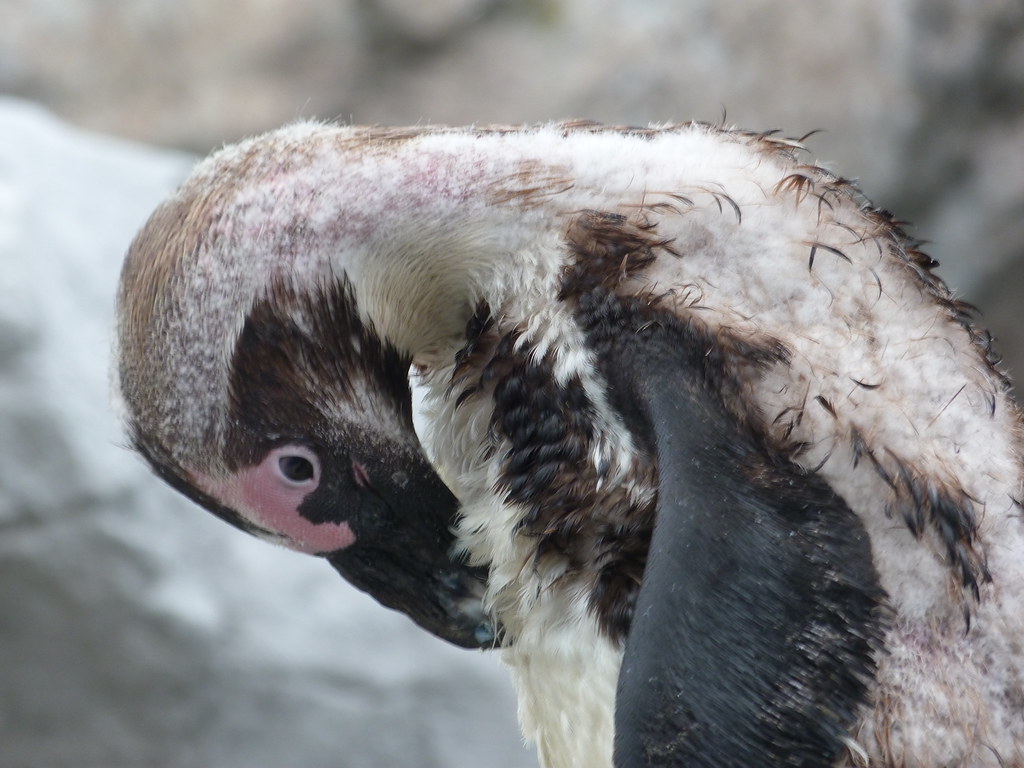
In my blog post last week, I said that the population of African penguins in Namibia is relatively stable compared to those in South Africa. However, that doesn’t mean that the Namibia population is immune from environmental stressors, like illness.
From mid-December 2018 to mid-February 2019, a devastating disease plagued the African penguin population on Halifax Island, Namibia. Although no other bird species on the island contracted the disease, over 350 African penguins died, most of which were breeding [1].
In order to discover what illness had afflicted the penguins, researchers took samples using swabs from three penguins that showed the following signs of illness [1]:
- Emaciation
- Lethargy or comatose behavior
- Twitching
- Uncoordinated movements
- Torticollis – a condition of the neck muscles that causes the head to droop
- Corneal opacity – scarring on the cornea that causes the eye to appear white
The researchers also performed an autopsy on five penguin carcasses. Although the penguins appeared fine on the outside, they discovered that the penguins had suffered hemorrhages and internal bleeding, especially along the gut [1].
From the swab samples, as well as a sample cut from the liver of a deceased penguin, the researchers sequenced the virus’s genome [1]. From this data, they found that the virus was H5N8 avian flu, a very severe strain [1].
While the researchers identified the virus that caused the outbreak, they cannot trace its origin [1]. It most likely reached Halifax Island through the movements of wild birds [1].
I think that one of the main takeaways from this study is that although the penguin population in Namibia is holding its own, it doesn’t take much to harm it. As a result, even the African penguin populations that we currently deem stable are still vulnerable.
References:
- Umberto Molini, Gottlieb Aikukutu, Jean-Paul Roux, Jessica Kemper, Charles Ntahonshikira, Giuseppe Marruchella, Siegfried Khaiseb, Giovanni Cattoli, and William G. Dundon (2020) Avian Influenza H5N8 Outbreak in African Penguins (Spheniscus demersus), Namibia, 2019. Journal of Wildlife Diseases: January 2020, Vol. 56, No. 1, pp. 214-218.
CCC
 The Penguin Researcher