Some of my favorite research to read on penguins are case studies because they provide a glimpse of how weird penguin behavior can get. Occasionally, a few penguins in a population might display a behavior they’re not supposed to do. In this case, a few African penguins began stealing one another’s nests, also known as nest usurpation, in response to extreme weather changes [1].
When African penguins lay their eggs in surface nests, they become susceptible to overheating [1]. In March 2017, extremely high temperatures caused some penguins in surface nests to lose their offspring, while ones in shady areas generally fared better [1].
By April, some penguins were successfully raising chicks in a nest while others were searching for territory to try to hatch replacement chicks [1]. Breeding out of time with one another caused territory-seeking penguins to be more aggressive than chick-raising penguins [1].
In their study, researchers Traisnel and Pichegru documented three instances of nest usurpation in the Bird Island penguin colony, which was previously undocumented in African penguins [1]. In the first instance, a bold chick-raising penguin defended her nest from an intruder until her mate came and both adults fended off the aggressive penguin [1].
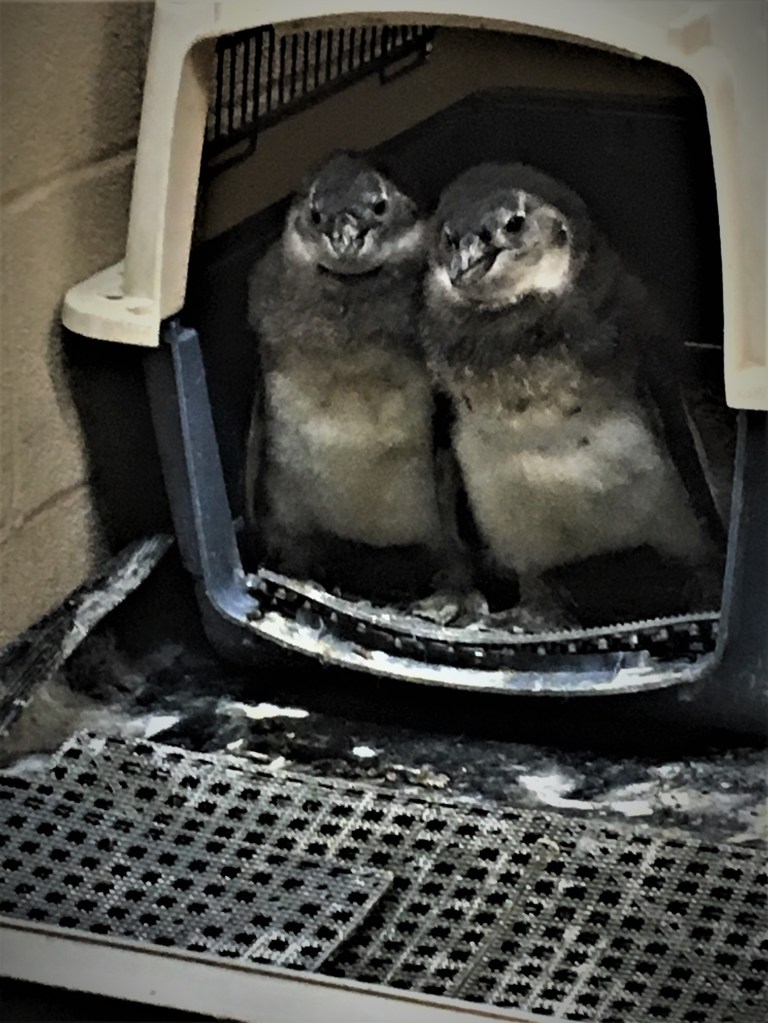
In the second occurrence, an aggressor chased a shy penguin off her nest, pecking her larger chick to death [1]. The smaller chick escaped the attack by running into a nearby nest [1]. It was sent to be hand-reared at a facility specializing in African penguin rehabilitation [1].
Finally, a penguin and its two chicks escaped an attack by abandoning their nest, and after six weeks, the adult was seen with only one chick in tow [1]. The aggressor raised two chicks in the stolen nest [1].
As a result, climate change is indirectly linked to negative interactions among penguins, like the death of healthy chicks [1]. Traisnel and Pichegru suggest providing ample artificial nests for penguins to reduce this unwanted behavior [1].
I hope you have enjoyed this blog, as this is my final post now that I’ve completed my requirements for class. Thanks for reading!
References:
- Traisnel, G. and Pichegru, L. 2018. Possible drivers of nest usurpation in African Penguins Spheniscus demersus. Marine Ornithology 46: 85–88.
 The Penguin Researcher